

Private dental bridge costs depend on type, materials and units replaced. In England, NHS bridges fall under Band 3 (£332.10); other UK nations use different charges. A consultation confirms pricing.
Missing teeth can make chewing less comfortable and leave a visible gap in your smile. A dental bridge fills that gap with an artificial tooth attached to neighbouring teeth or dental implants. The dental bridge cost UK patients pay depends on the design, materials and number of units required. Your dentist can assess your teeth and provide a personalised estimate.
Key Takeaways
- NHS dental bridges in England cost £332.10 under Band 3 per course of treatment, while private prices at Stotfold Dental Clinic start at £350 for a Maryland replacement tooth plus £150 for its supporting wing.
- Private metal-bonded bridges start at £950 per unit, while all-ceramic bridges start at £1,100 per unit.
- Conventional bridges use crowns on neighbouring teeth, Maryland bridges use bonded wings, and implant-supported bridges attach to dental implants.
- Request a personalised treatment estimate covering assessment, preparation, laboratory work, fitting and adjustments before agreeing to treatment.
What Is a Dental Bridge and How Does It Replace Missing Teeth?
A dental bridge is a fixed restoration that replaces one or more missing teeth with artificial teeth called pontics. It fills the gap and stays in place through support from natural teeth or dental implants.
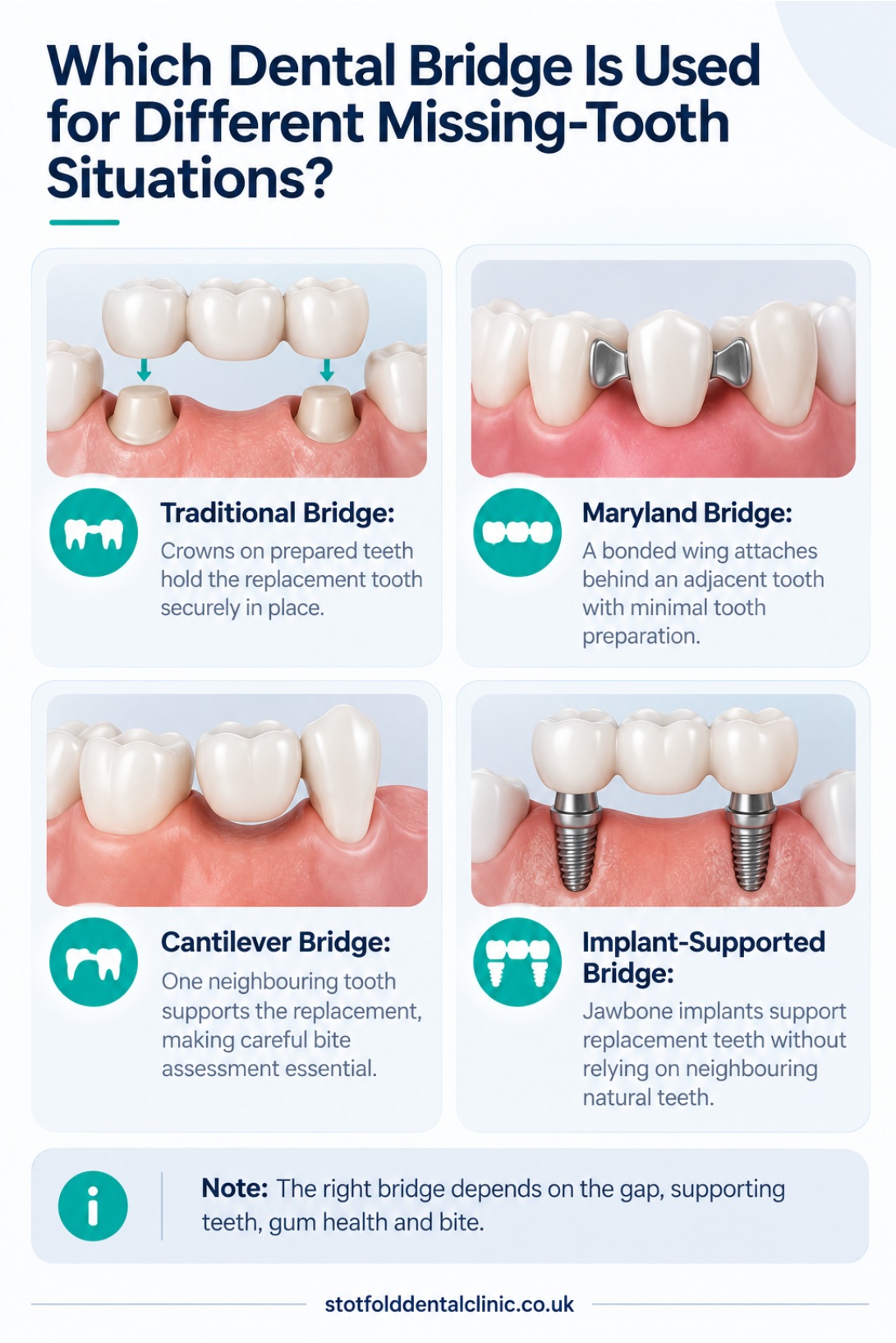
A conventional bridge uses crowns fitted over prepared teeth on either side of the gap.A Maryland bridge typically involves:
- A metal or composite wing
- Bonding to an adjacent tooth
- Placement behind the supporting tooth
- Minimal removal of natural tooth structure
This makes it a more conservative option than conventional bridges in suitable cases. Implant-supported bridges attach to implants placed in the jawbone rather than relying on neighbouring teeth.
Unlike a removable denture, a bridge is generally cemented or bonded in place and cannot be removed by the patient. It can restore chewing function, fill a visible gap and improve the appearance of the smile.
How Much Do Different Types of Dental Bridges Cost?
Comparing dental bridge prices can be confusing when different designs are charged in different ways. At Stotfold Dental Clinic, a Maryland bridge has separate fees for the replacement tooth and supporting wing, while metal-bonded and all-ceramic bridges are priced per unit. The clinic’s starting fees are shown below:
| Bridge type | Starting price per unit |
|---|---|
| Maryland (resin-bonded): replacement tooth | From £350 |
| Maryland (resin-bonded): supporting wing | From £150 |
| Metal-bonded bridge | From £950 |
| All-ceramic bridge | From £1,100 |
Note: The final quote depends on the number of units, the supporting teeth involved, and the recommended design. A dentist needs to assess your teeth before confirming which option is suitable and what the treatment will cost.
For NHS treatment in England, a dental bridge falls under Band 3, currently £332.10 for the entire course of treatment. You do not pay that fee separately for every tooth in the bridge. The NHS guide to dental charge bands confirms that patients pay once for the highest band of treatment required within a course.
The England charge does not apply across the whole UK, as Wales, Scotland and Northern Ireland use different NHS dental charging arrangements.
How Much Does a 3-Unit Dental Bridge Cost?
For example, a three-unit metal-bonded bridge using a starting price of £950 per unit would cost £2,850 (£950 × 3). This is a worked example, not a quotation. Your dentist will confirm the number of units needed and whether additional treatment affects the total.
Does Dental Bridge Treatment Include Consultation and Fitting?
A private quote should clarify what is included before you agree to treatment. Check whether the quoted cost covers:
- Initial assessment
- X-rays, where needed
- Preparation of supporting teeth
- Laboratory fabrication
- Temporary bridge, if required
- Final fitting and bite adjustments
Ask about any separate review or follow-up fees, too. Clarifying these details upfront helps avoid unexpected charges during treatment.
The General Dental Council’s Standards for the Dental Team require dental professionals to provide clear information about costs and support informed consent. This means you should receive a realistic estimate before treatment starts, understand the proposed costs and be told about changes to the estimate so they can be agreed and documented.
What Are the Different Types of Dental Bridges?
The most suitable design depends on where the tooth is missing, the condition of nearby teeth, and how your bite loads the replacement.
Traditional Dental Bridges
A conventional bridge uses crowns placed over natural teeth on both sides of the gap to support the replacement tooth. Those supporting teeth need preparation, so their existing health and strength matter when choosing this design.
Maryland Bonded Bridges
A Maryland bridge has a metal or composite wing bonded behind an adjacent tooth, usually preserving more natural tooth structure than a full crown. A 2015 Bristol Dental Hospital and Cardiff University study reported estimated survival of 80.8% at five years and 80.4% at ten years.
The researchers identified bridge design and operator experience as important factors, so these results are not a guarantee for an individual patient.
Cantilever Dental Bridges
A cantilever bridge is supported by a natural tooth on one side of the gap only. This concentrates the supporting load differently, so it suits only selected situations after a dentist assesses the bite and the supporting tooth.
Implant-Supported Dental Bridges
An implant-supported bridge attaches to dental implants placed in the jawbone rather than relying on natural teeth beside the gap. It may replace several missing teeth, but suitability depends on bone conditions, gum health and whether implant surgery is appropriate.
Dental Bridge vs Dental Implant vs Denture
Each option replaces missing teeth differently, affecting how it feels, stays in place and affects surrounding teeth.
A dental bridge fills the gap using neighbouring teeth or implants for support. A conventional bridge is fixed in place but may require healthy neighbouring teeth to be reshaped.
An implant replaces the missing tooth root with a fixture in the jawbone, supporting a crown or bridge without relying on neighbouring natural teeth. However, implant treatment involves surgery and healing time.
A denture is removable, can replace several missing teeth and must be taken out for cleaning, but may feel less stable than a fixed restoration.
The right choice depends on your oral health, bone suitability, treatment time and budget. A dentist can compare these options through restorative dentistry and explain the likely costs and maintenance for your situation.
What Happens During Dental Bridge Treatment?
Treatment usually involves at least two appointments and is carried out under local anaesthetic. The exact process depends on the bridge design, particularly whether supporting teeth need preparation.
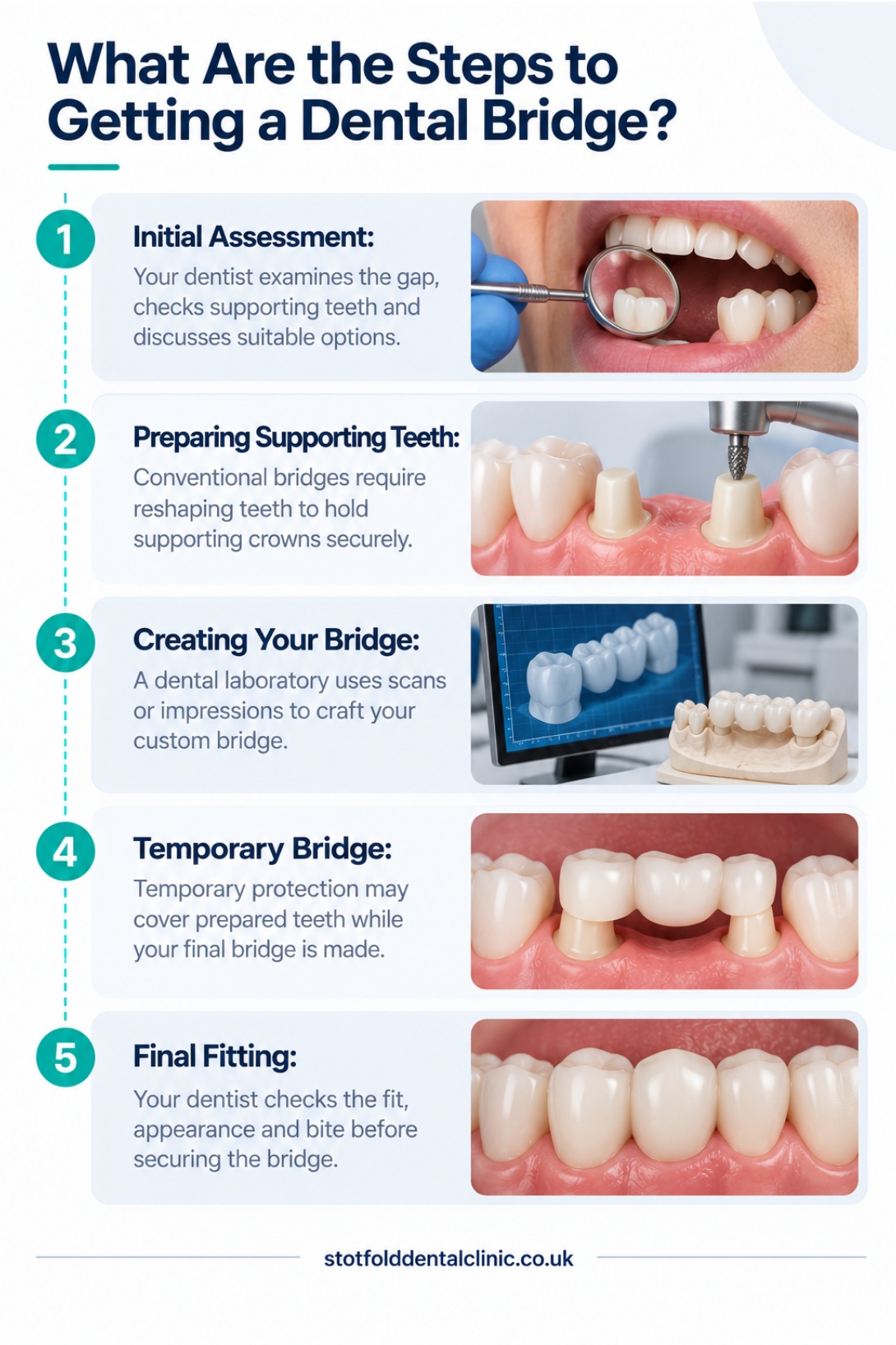
One thing to ask your dentist before treatment is how long you’ll need to wait for the permanent bridge. If your supporting teeth need reshaping, a temporary bridge may be fitted while the dental laboratory makes your final restoration. Your dentist can explain what you’ll be wearing between appointments and whether you’ll need to take any extra care when eating.
What Results Can You Expect From a Dental Bridge?
A dental bridge fills the gap left by a missing tooth and can restore a more complete-looking smile. It also helps restore chewing function, although the improvement depends on the position of the missing tooth and the overall condition of your mouth.
Your dentist selects a suitable shade, shape and material to blend with the surrounding teeth. The result can look natural, but it may not match a natural tooth exactly. The cosmetic result is influenced by:
- Bridge design
- Nearby tooth condition
- Gum appearance
- How much of the replacement tooth shows when smiling
The more visible the replacement tooth is, the more important its colour, shape and alignment become.
A bridge can also take time to feel familiar when chewing or speaking. Follow the cleaning advice provided by your dentist, especially for the area beneath the replacement tooth, where food and plaque can collect.
How Long Do Dental Bridges Last?
Dental bridges can remain functional for years, but their longevity depends on the design, supporting teeth, position in the mouth and ongoing dental care.
A University of Birmingham study published in 2012 analysed records for more than 80,000 adult NHS patients in England and Wales. It found that conventional bridge abutments, the teeth supporting the bridge, had a 72% survival rate at ten years. The study also found that bridge type, tooth position and attendance patterns affected outcomes.
This is an older study, but it provides a large UK evidence base. Its 72% figure relates to the supporting teeth under the study’s definition of survival, not a guarantee that every bridge lasts ten years. Regular check-ups and cleaning around the bridge help your dentist monitor the supporting teeth and gums.
When Should You Contact Your Dentist?
Contact your dentist promptly if you experience persistent pain around a bridge, swelling of the gums, or a bridge that feels loose or becomes dislodged. These symptoms may indicate problems with:
- The restoration itself
- The supporting tooth
- Surrounding gum tissue
- Other tissues around the bridge
A dental examination can help identify the cause and determine whether treatment is needed.
If the bridge comes out, keep it safe and tell your dentist what happened. Do not try to secure it with household glue. Your dentist can advise whether it can be refitted or needs repair or replacement. Seek urgent medical help if swelling is severe or you have difficulty breathing or swallowing.
Am I Suitable for Dental Bridge Treatment?
Suitability depends on the health and strength of the teeth that would support the bridge, the condition of your gums and the position of the gap. Your dentist will also consider your bite and whether an implant-supported bridge or another replacement option would be more appropriate.
The Adult Oral Health Survey 2023, published by the UK government, found that only 2.5% of adults in England reported having no natural teeth, while 86% of adults who retained natural teeth had 21 or more. These figures show that complete tooth loss is uncommon and many adults retain natural teeth.
However, the national statistics cannot establish whether your particular supporting teeth are healthy enough for a bridge. That requires an individual dental assessment.
FAQs
How Much Does a Dental Bridge Cost in the UK?
Private prices at Stotfold Dental Clinic start at £350 for a Maryland replacement tooth, plus a wing from £150. Metal-bonded bridges start at £950 per unit.
Is a Dental Bridge Cheaper Than an Implant?
It can be, but the total depends on the bridge design, number of units and implant treatment required. Compare personalised written estimates.
Can You Have a Dental Bridge for One Missing Tooth?
Yes. A conventional, Maryland or cantilever bridge may be suitable, depending on the gap and supporting teeth.
Can You Get a Dental Bridge for Two Missing Teeth?
Sometimes. Suitability depends on the length and position of the gap and whether the supporting teeth or implants can safely carry the load.
How Soon Can You Eat After Getting a Dental Bridge?
Follow your dentist’s advice. Wait until any numbness has worn off and follow their recommendations about foods while you adjust to the bridge.
Conclusion
A dental bridge can replace missing teeth and restore chewing function, but the right design and cost depend on your oral health and treatment needs. Compare the options, ask what your quote includes, and discuss the long-term care required before deciding.
Book a free consultation to discuss your options and receive a personalised treatment estimate.
This article is for general information only and should not replace professional dental advice. If you would like to understand dental bridge costs, find out which type may suit your needs, or compare NHS and private treatment options, book a consultation with one of our dentists for a personalised assessment and treatment estimate.

